


[Eng] Where Dance Breathes Through Time: Reflections on APAC Symposium 2025 | 舞在當下,留案未來:APAC Symposium 2025 的身體反思
- May 30
- 11 min read
Updated: 1 day ago
Text: Ivy Tsui
Dance, to me, is an art of the present moment. Whenever I return to all ever-changing questions of ‘my relationship with dance’, understanding its past becomes a crucial pathway. It allows me to encounter and re-encounter dance anew and opens wider landscapes for me to dance in the future.
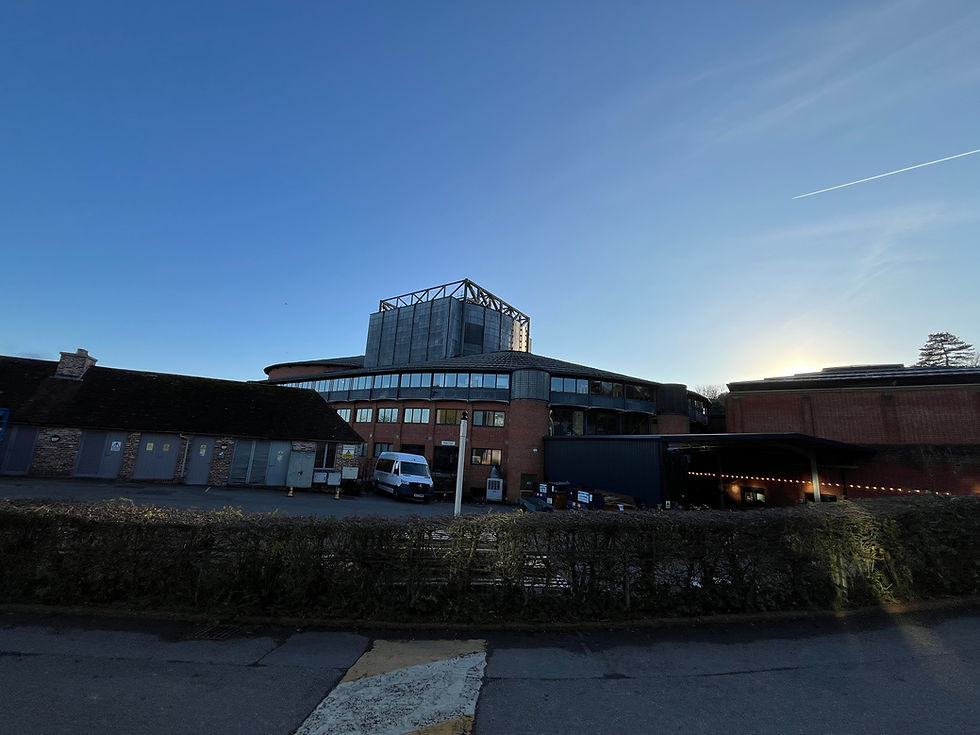
Photo: Ivy Tsui
I often think of dance as fire. It has no fixed form, yet it is intense and carries a luminous energy that can ignite human connection. As a person with a finite life, it feels natural to feel an urgent desire to share this 'fire of dance' within my limited lifespan. Yet when I place myself within a larger historical scale, curiosity and questions inevitably arise. How did people dance before I was born, or even a hundred or a thousand years ago? When this spark of 'fire' was first passed into my hands at the age of six, how did I understand such a tiny yet powerful flame?
Since 2015, I have yearned to understand my own practice and creative path. Finally, during my master's studies, I began to observe and organize my reflections and artistic practice as a dance artist. During this process, I continuously looked back at and interacted with video recordings of my own dancing. Even though these videos had sometimes lost their original documentary intent and were occasionally filmed just for memorising steps and the satisfaction of recording, the process of gazing, responding, acting, organising, and reflecting allowed me to 're-choreograph' dance steps, moving images, and writing. This process invited me to let go of my past self, relearn, and assign new meanings, awakening my awareness of the present and spark my creativity.
I noticed I use dance itself as a ‘method’ to understand dance and the world. Through dance training, performing, teaching, and choreographing, I continuously observe and test the functions and effects of dance in different contexts.
Over time, I have come to realise that my learning, practice, and sharing of dance are always negotiating relationships with dance, as well as my imagination and perspective of it. This constantly changes my methods of creating and transmitting dance, while always dealing with the relationship between the ‘past’, ‘present’, and ‘future’. I wrote my observations, analyses, and reflections into my master's dissertation [1], proposing 'My Body Map' to analyse how up to seven layers of information rush in, are perceived, understood, recalled, permeated back and forth, organised, and responded to in a single moment. This multi-directional flow of actions and decisions happens between my body while dancing and during daily life.
This dissertation, centered on my own artistic practice, had the honour of being presented as an extended paper [2] at the 34th SIBMAS Conference held in Hong Kong in 2024 [3]. The conference paper focused on the physical sensations and discoveries during my interaction with my own video archives, sharing how editing exercises and choreographic exercises inspire each other, while also sparking my interest in performing arts archives.
After participating in the SIBMAS conference, I learned about and joined the Association of Performing Arts Collections [4] (APAC; founded in London in 1979, an UK-based organisation and networks focused on the study of performing arts collections). As an independent member for over a year, I have participated in multiple conferences, themed forums, research discussions, and networking events like 'Coffee Roulette,' gradually stepping into this community composed of archive professionals and practitioners concerned with performing arts archives.
With the support of APAC, I am able to participate in the APAC Symposium 2025 held in November 2025. The symposium venue is located at Glyndebourne [5], an opera house in East Sussex, UK.



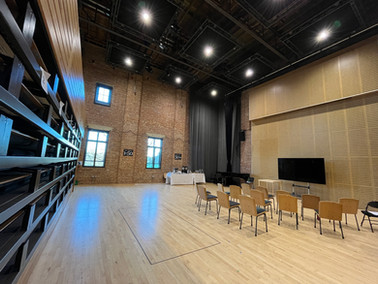


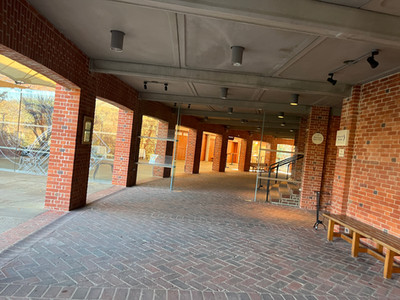
Photo: Ivy Tsui
Glyndebourne is about a one-hour drive from London. Upon arriving at the venue, the first thing I felt was a natural interweaving of the old and the new, the indoor and the outdoor, accompanied by a relaxed and open sense of welcomeness. It is a place that invites the body into a state of "in-between-ness"—as if opening the pores of the skin to let the air pass through the body, mirroring the very inhalation and exhalation of an opera singer in song.
Through the explanations of the theater staff, I learned that Glyndebourne was founded in 1934 by John Christie and his wife, Audrey Mildmay, who hosted the summer festival (Glyndebourne Festival) here that same year—a tradition that continues to this day. In 1994, a new opera house capable of seating approximately 1,200 people was rebuilt. Every building material and structural choice was carefully designed specifically for opera, ensuring that sound is precisely transmitted and balanced during rehearsals and performances, a detail that the staff highlighted during the guided tour.
Later, the archive staff introduced us to the Glyndebourne Archive [6]. Established in 1988, its collections include production records, extended artworks, posters, costumes, and various performance-related objects. From the archival team's presentation, one could deeply feel that these materials do not exist merely as records of the past; instead, they function as layered traces of memory. This is particularly prominent within the costume archives. The measurements, wear, and sweat stains on the garments chronicle the physical bodies that once inhabited them, while the original fabrics and colors extend the avant-garde imagination of that era. These objects do not simply preserve the final results of a finished production; they also echo how the body enters a space, how sound is shaped, and how artistic practice is understood and reinterpreted over time. Furthermore, through educational collaborations and activities with various institutions, the archive ensures that these designs continue to inspire a new generation of creators.
Spending an entire day in a venue so deeply filled with a passion for opera, and listening to five presentations delivered by Abigail Williams (V&A), Dr. Kate Dorney (University of Manchester), Dr. Vanessa Tothill (Sainsbury Centre for Visual Arts, University of East Anglia), Dr. Erin Lee (National Theatre), and Dr. Patricia Akhimie and Dr. Verónica Betancourt (Folger Shakespeare Library), was a true joy, learning from their experiences and insights was profoundly refreshing.
Archive as an Encounter with the Past
“We are missing the boring stuff.” This was one of the most memorable statements raised by Abigail Williams, an archivist for the V&A Museum's David Bowie Archive [7], during his presentation titled The Making of the David Bowie Archive: David Bowie as Curator, was the most striking and memorable line for me.
Abigail discussed his experience and process of managing the David Bowie Archive, highlighting the highly intertwined, complex, and interconnected relationship between the artist, the work, and the archive itself. Abigail mentioned that as early as the 1990s, Bowie was already aware of the importance of archiving. During his lifetime, Bowie collaborated with an archival team to actively establish a repository to preserve his own documentary records, an archival endeavor that has continued even after his passing. While the collection encompasses his photographs, album cover designs, memorabilia, creative notes, collaborators' drafts, press clippings, and fan letters, it noticeably lacks materials such as tour itineraries, bills, or administrative documents. From an archival perspective, Abigail pointed out, these "boring things" seem to be missing.
For me, this serves as an incredibly illuminating case study. Some of Bowie's works belong, to an extent, to the performing arts, which, much like dance, are inherently ephemeral. When building an archive, deciding what should be kept, what should be discarded, and how materials should be categorised is a negotiation determined partly by the artist and partly by the archivist. This prompted me to consider the misalignment between the "artist" and the "archivist": What materials are deemed too mundane, too ordinary, too trivial, or even too "boring" to be worth preserving? Are these materials truly unimportant? Or could they, conversely, be vital traces of time?
The presentation also touched upon how sticky notes and personal notes become part of the cataloging process. This led me to pay closer attention to archival techniques within daily life, and how private, domestic archival practices influence our understanding of creative production. Through this sharing session, my comprehension of the "archival ecosystem" expanded significantly; it is not a static preservation system, but rather a dynamic and living network shaped by time, intention, and everyday actions.
Dance as an Experience of Now
Reflecting on my own creations, I have gradually come to realise that I have always been drawn to the concepts of decay and disappearance, as seen in works like Dehydrated Flowers (2012) [8] and Frangipani (2015) [9]. These preoccupations are intimately linked to the phenomenon of change over time, acting as a counterpoint that highlights vitality and the present moment. In the process of creating these pieces, I learned to understand and compose dance through the texture of movement, alongside its sense of topography and spatial relationships on stage.

Photo: Ivy Tsui
I believe that the narratives of these works encompass movement details from both inside and outside the dancer's body. What I refer to as "inner lives" are the somatic elements embedded within my chosen movement vocabulary, such as rhythm, tension, tactility, temperature, texture, and other sensory components. Conversely, "outer lives" pertain to the dancer's positioning, orientation, and pathways of movement within a specific or designed space. Together, these internal and external choices constitute a dance experienced in the immediate present, while simultaneously pointing toward its inevitable destiny of disappearance.
Within my ongoing research project, My Life as a Dancer? (2021–present) [10], I have begun to recognise more clearly that "time" is a shared core concern of both dance and the archive. Operating across multiple roles simultaneously, as a dancer, choreographer, artist, and archival practitioner for my own works, I constantly negotiate how dance exists as a "here-and-now experience," while leaving behind traces that may not be preserved indefinitely. I increasingly feel that neither dance nor archiving attempts to stop time; rather, they shape how time flows, how it is remembered, and how disappearance can become a different form of presence.
Immersed in these reflections, I return once again to the question posed by Toni Sant [11]: “...what happens and needs to happen when a document is created, how archives work, and what needs to happen to document for it to become part of the documentation of a performance. ”(Sant 2017) [12]. Perhaps, this inquiry applies not only to theatrical performances but also to those ‘bedroom dances’ witnessed only by a camera. What kind of evidence and witnessing do we need to truly understand dance?
Imagining Futures: Archive Not as Preservation, but as a Choreography of Time
I have come to understand the archive not as a container for preserving time, but as a choreography of time itself, a system that orchestrates temporal flow. Archival practice invites what is included, what is delayed, what vanishes, and what is permitted to return. The archive does not freeze the passage of time; instead, it organises how time moves, folds, and becomes easier to access, at least for the person who created it.
This understanding opens a space for imagining the future for me. It is no longer something to be predicted or determined, but rather functions like a rehearsal. I find myself drawn to drawn to the idea of glitch feminism [13], not as a strict methodology, but as an attitude. To me, a glitch is not merely a transient error or malfunction within digital codes or programs; it is an attitude that interrupts linearity, resists coherence, and exposes gaps within dominant systems of knowledge. In my experience of organising my own choreographic archives, glitches appeared in moments of incomplete documentation, misfiled, or instances that refuse categorisation. These failures and overflows point toward alternative ways of understanding, or perhaps even alternative futures. Just as dance can reject linear narratives and fixed forms, a glitch disrupts the contextual structures within both the digital and embodied realms, allowing multiple, incomplete, and fragmented bodily memories to surface.
Within this framework, I begin to view the methodology of ‘autoethnography’ as a prospective direction for future research, whether in choreographic or digital contexts. While archives often prioritise the preservation of institutionally constructed narratives, what happens when we treat the "self", permeated with contradictions, memories, physical sensations, and potential doubts, as a valid archival site? My practice exists within the everyday: in training, repetition, fatigue, and aging. The materials generated therein are both fragile and fragmented, yet they may reveal how an artistic life is shaped across multiple cultural contexts, and how the body, or its digital representation, remains influenced by stereotypes and assumptions.

Photo: Ivy Tsui
These reflections did not form in isolation; they were catalysed through my participation in the APAC Symposium and its related activities. Being present at Glyndebourne, navigating between presentations, guided tours, dialogues, and shared teas and meals, allowed me to experience the thinking within performing arts archives through a collective, communal lens.
Conclusion: Dancing the Present, Archiving the Future

Photo: Ivy Tsui
As a dance artist and someone learning to work alongside archives, I have gradually come to realise that perhaps my role is not to leave behind flawless, airtight evidence of dance, but rather to leave behind sufficient ‘human warmth’. This warmth resides within bodily memories, daily notes, misplaced materials, and those so-called "boring things." These traces may be neither clear nor stable, yet they nest the potential to be received by another body in the future.
If the fire of dance can traverse time, then perhaps the archive is not its vessel, but its air. It allows the flame to breathe, to turn, and perhaps even to extinguish, yet also to be ignited once again. The dance of the future exists not only on the stage but also within the gaps of the archive, awaiting the next encounter. Thus, we can collectively ask: How can dance artists develop archival practices that respect and honour embodied knowledge? Can "community archives" expand and diversify dance histories? And can choreography itself be expanded into an archival act?
Footnotes:
[1] My Life as a Dancer? – A Practising Investigation in/on My Artistic Practice / Yik Chit Tsui (2023) – Trinity Laban Research Online. n.d. Accessed 12 January 2026. https://researchonline.trinitylaban.ac.uk/oa/thesis/my-life-as-a-dancer-a-practising-investigation-in-on-my-artistic-practice-yik-chit-tsui-2023/.
[2] Translating Light: A Reflection on My Creative Dance Practice Informed by Embodied Archives (2024). The conference proceeding, Dramaturgies of Collecting: Conserving, Restaging, and Interpreting the Performing Arts, expecting to publish in 2026 June.
[3] 34th SIBMAS Conference 2024 Hong Kong. n.d. ‘Hong Kong 2024’. Accessed 12 January 2026. https://sibmashk2024.iatc.com.hk/.
[4] APAC. n.d. ‘APAC Homepage’. Accessed 12 January 2026. https://performingartscollections.org.uk/.
[5] Glyndebourne. n.d. ‘Home’. Accessed 12 January 2026. https://www.glyndebourne.com/.
[6] ‘Home | Collections Online’. n.d. Accessed 12 January 2026. https://glyndebourne-col.collectionsindex.com/home. https://glyndebourne-col.collectionsindex.com/home
[7] Victoria and Albert Museum. n.d. ‘David Bowie – Explore the Collections · V&A’. Accessed 13 January 2026. https://www.vam.ac.uk/collections/david-bowie.
[8] 《乾花》(2015)節目資料: 香港舞蹈年鑑 2015- 徐奕婕《乾花》舞蹈新鮮人系列
https://www.hkdanceyearbook.org/main/dance/chi/prog_details.php?id=3-2908 相關舞評:(1)一個人的舞蹈劇場 - 略談《乾花》與《37°C》William W.Y. CHAN(本文首刊於《舞蹈手札》Vol. 17 No.2〔2015 年 4-5 月號〕)
https://williamwychan.wixsite.com/blog2015/single-post/2015/04/25/%E4%B8%80%E5%80%8B%E4%BA%BA%E7%9A%84%E8%88%9E%E8%B9%88%E5%8A%87%E5%A0%B4-%EF%BC%8D-%E7%95%A5%E8%AB%87-%E4%B9%BE%E8%8A%B1-%E8%88%87-37-c (2) 評徐奕婕《乾花》洛楓. (原刊於香港:《Art Plus》2015年3⽉月號) https://www.iatc.com.hk/theatre2015/?a=doc&id=101244
[9] 《雞蛋花》(2015)節目資料:P.49. Issuu. 2025. ‘The Hong Kong Jockey Club Contemporary Dance Series - 43rd Hong Kong Arts Festival’. May 23. https://issuu.com/hkartsfestival/docs/the_hong_kong_jockey_club_contempor_81f95910193582.
相關舞評:Escoda, Carla, ContributorDance, theatre, Arts Critic, and based in San Francisco. 2015. ‘12 Hot Young Choreographers Strut Their Stuff at the Hong Kong Arts Festival’. HuffPost, March 17. https://www.huffpost.com/entry/12-hot-young-choreographe_b_6883318.
[10] ‘My Life as a Dancer?’ 2026. Danceivydance, February 6. https://ivytsui.com/2026/02/06/my-life-as-a-dancer/.
[11] Toni Sant is an award-winning writer, broadcaster, and academic from Malta who serves as an Associate Professor and Director of the Digital Curation Lab at the University of Salford,. His radio career began in the 1980s with Radio Malta, later transitioning to hosting music and entertainment programming on TVM. Exploring interactive online media, he established the MaltaMedia Online Network and founded his flagship weekly podcast, Mużika Mod Ieħor, in 2005. He co-founded the M3P Foundation in 2010 and remains heavily involved with the Wikimedia initiative. (information taken from https://www.tonisant.com/)
[12] Sant, Toni. 2017. Documenting Performance: The Context and Processes of Digital Curation and Archiving. Bloomsbury Methuen Drama, an imprint of Bloomsbury Publishing Plc. 1.
[13] ‘#GLITCHFEMINISM - Legacy Russell’. n.d. Accessed 12 January 2026. https://legacyrussell.com/GLITCHFEMINISM.
====================================
Ivy Tsui
Ivy Tsui (she/her) is a Hong Kong-born, London-based dance artist, researcher, and writer. Her practice spans performance, choreography, moving image, and writing, exploring the relationships between the body, memory, language, and identity. She approaches dance as a method, and uses moving image and archival processes to reflect on the connections between practice and time. Her ongoing project My Life as a Dancer? works with personal dance video archives to investigate the formation and transformation of artistic identity. She also contributed to Dance Journal/HK through her column Choreo-Word-Graphy, developing writing as an extension of choreographic practice. In 2024, she presented her research at the 34th SIBMAS Conference, examining the relationship between embodied archives and dance-making. www.ivytsui.com Facebook/ Instagram: @danceivydance
![[中] [Eng] 延續的脈絡:從不可思議印度藝術節看印度舞在香港的根與路 Continuity in Motion: Weaving the "Thread of Tradition” of Indian Dance in Hong Kong](https://static.wixstatic.com/media/f99599_45e1ffeba9db4a0bbc550d0c3b381d05~mv2.jpg/v1/fill/w_980,h_701,al_c,q_85,usm_0.66_1.00_0.01,enc_avif,quality_auto/f99599_45e1ffeba9db4a0bbc550d0c3b381d05~mv2.jpg)
![[中] 從「人文與科技」國際研討會想像未來: 可及多元](https://static.wixstatic.com/media/f99599_8f6300984e454178bfa09a3f8c626373~mv2.jpg/v1/fill/w_980,h_653,al_c,q_85,usm_0.66_1.00_0.01,enc_avif,quality_auto/f99599_8f6300984e454178bfa09a3f8c626373~mv2.jpg)
![[Eng] OOTFest25 (UN)SEEN: Vision, Dialogue, Experimentation and Paradoxes](https://static.wixstatic.com/media/f99599_c976f913ce8e4317816053a968bacc70~mv2.jpg/v1/fill/w_980,h_551,al_c,q_85,usm_0.66_1.00_0.01,enc_avif,quality_auto/f99599_c976f913ce8e4317816053a968bacc70~mv2.jpg)
Comments