


[Eng] “Kung Fu Artistry”: The Unique One
- Jan 5
- 5 min read
Text: Angela Lee
In 2025, commemorating the 85th birthday of Bruce Lee (李小龍/1940-1973), Hong Kong Dance Company, led by Yang Yuntao (楊雲濤) as Artistic Director, presented its Grand Dance Drama Kung Fu Artistry: Bruce Lee’s No Way as Way as a tribute to this legend as well as an advance celebration of the company’s 45th Anniversary.
In the hearts of fans, Lee is not only an internationally renowned megastar, but also a great philosopher. He was the founder of Jeet Kune Do (截拳道) which incorporated various schools of martial arts theories and practices. Its core idea is “using no way as way”, emphasizing flexibility, simplicity and practicality.
Lee was born in the United States and grew up in Hong Kong. When studying and working in the US in the 1960s, he founded the Jun Fan Gung Fu Institute (振藩國術館) and introduced Chinese Kung Fu to the public through television programmes and movies. In the early 1970s, he returned to Hong Kong and participated in film productions. Behind the spotlight, he loved reading and expressing his emotions and thoughts in writing. He had an impact which has prevailed across generations until today.
The Prologue, Beginning, commences with Lyu Mingqian (呂明謙), a child performer, demonstrating a set of martial arts movements in the dark. This symbolizes Lee starting his acting career when he was a little boy.
Act 1 - Youth in Flames – divided into four scenes, portrays the lively and rebellious adolescence of Lee, who is portrayed by Ong Tze Shen (王志昇). The retro costumes and hairstyles of the dancers evoke 1960s fashions. Enlightenment and Fulfillment show how Lee was fond of both traditional Chinese martial arts and western Cha-cha dance. The blended rhythm and charm of Chinese classical dance and Cha-cha group dance is appealing and elegant. Lee dances with two female partners on a dance stage assembled from wooden blocks. Then, the small dance stage becomes a single combat platform for boxing. Lee battles with his opponent, danced by Ho Ho-fei (何皓斐). Afterwards, the platform splits up to become a small bridge leading Lee to go onboard ship.


Photo: Ray Cheung (first photo) & Worldwide Dancer Project (Photos provided by the Hong Kong Dance Company)
Lee starts a new page by sailing Across the Sea. While living overseas, he encounters Challenge when he introduces Chinese Kung Fu to the American public. Lee’s Chinese Kung Fu costume stands out among other dancers dressed in judogi uniforms who represent apprentices of other schools of martial arts, such as karate and jiu-jitsu. Lee faces another battle from a challenger, portrayed by Lee Chia-ming (李家名), for Chinese Kung Fu. Days are filled with sparring and confrontations with those who want to throw down the gauntlet to Lee.


Photo: Ar Liu @ Arliugraphy (first photo on the left) & Worldwide Dancer Project (last 2 photos on the right) (Photos provided by the Hong Kong Dance Company)
Then a short, quiet scene shows his wife putting a blanket over the body of an exhausted Lee, who is sleeping on a chair in his study at home. He wakes up and reads books. This paves the way to how Lee develops his philosophy advocating Firmness, Gentleness, Authenticity in Act 2.
Surrounded by a circle of Wing Chun wooden dummies (木人樁), Lee is Seeking the Way of Chinese Kung Fu with other male dancers. This wooden dummy is a typical training tool used for persistent practice to develop power and co-ordination without a partner. Lee’s self-learning process further explores advocating striking to be Like Water: formless and shapeless. As he said, “Be water, my friend.” The flowing water, waves and “yin-yang” sign created by the extended reality (XR) effects incorporates Ong’s movement smoothly on stage.
One of the highlights of the XR images is the renowned Hong Kong actor Aaron Kwok’s calligraphy piece, which inscribes Lee’s name in the shape of his iconic Jeet Kune Do pose. Live jazz music played by Patrick Lui (pianist), Nate Wong (drummer) and Wong Tak Chung (double bassist) raises the mood from the previous watery steadiness to fiery excitement while Ong and his fellow dancers, whose faces are covered by hooded sweatshirts, perform the “Jeet Kune Dance” that emphasizes efficiency, adaptability and personal expression.
In Act 3, the grand group sequence Stardom reveals that Lee himself is like The Moon Reflects in Ten Thousand Rivers. Performed by different male dancers, this scene shows how Lee shines and reaches the climax of his film career by acting various famous roles, including Kato in the TV series The Green Hornet (1966-1967), Chen Zhen in Fist of Fury (1972), a martial arts instructor from Shaolin Temple in Enter the Dragon (1973) and a retired champion martial artist dressed in the iconic yellow track suit in his unfinished work The Game of Death (1978). In contrast, Ong sits quietly and writes down his reflections and thoughts in journals and poems. The texts projected above the stage illustrate how this martial arts master actualized himself to be an artist of life.

Photo: Ar Liu @ Arliugraphy (Photo provided by the Hong Kong Dance Company)
In the film Enter the Dragon, Lee quotes a Buddhist idiom, “like a finger pointing away to the moon, don’t concentrate on the finger or you'll miss all the heavenly glory”. He uses the moon to emphasize the importance of focusing on the ultimate goal. Moreover, in a poem which he wrote in 1963, Walking along the bank of Lake Washington, the last four sentences are:
“A dazzling moon
Shines down from the lonely depths of the sky.
In the moonlight slowly I move to a Kung Fu Form.
Body and soul are fused into one.”
Under the moonlight, he can empty his mind in pursuit of excellence in the martial arts. Then Ong and Lyu perform martial arts under the Moonlight while Lui plays the piano. The legacy of the beauty of combining martial arts and mindfulness will influence generations to come.

Photo: Worldwide Dancer Project (Photo provided by the Hong Kong Dance Company)
The Epilogue, The Legend, is a grand group sequence demonstrating the accomplishments of the company’s dancers, who have undergone constant martial arts training for the past eight years. Dressed in smart white Chinese tunic suits, every dancer, no matter male or female, is manipulating red nunchakus while moving and dancing to live jazz music. The band plays the energetic theme song from Lee’s The Way of the Dragon (1972), composed by Joseph Koo, with additional musicians: Clem Fung (guitarist), Ferdinand Pantig Jr (trumpetist) and Yu Hagiwara (saxophonist). Thousands of photos of Lee, at different stages of his life, are displayed above and along both side of the stage. This leads the audience through a time tunnel to witness his achievements. The LED lighting is fascinating and nostalgic with different patterns glowing on the floor. Despite one of the female dancers dropping the nunchaku during a fast movement, her calm, swift reaction in picking it up for continuity demonstrated the artist’s professionalism in handling an unexpected hitch. This dance with nunchakus is exceptionally impressive and stunning in its uniqueness.


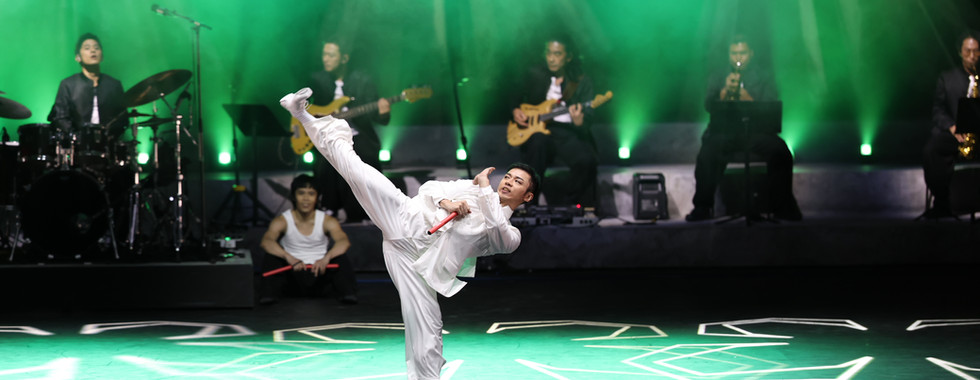


Photo: Worldwide Dancer Project (photos 1, 2, 3, 6) & Ray Cheung (photos 4, 5, 7, 8) & Ar Liu @ Arliugraphy (last photo) (Photos provided by Hong Kong Dance Company)
This dance drama is highly recommended especially for youngsters who may encounter struggles and difficulties in growth. Bruce Lee’s extraordinary legend is an everlasting inspiration to encourage people to discover their unlimited potential and overcome every challenge in life.
“Kung Fu Artistry: Bruce Lee’s No Way as Way”
Presented by Hong Kong Dance Company
Director and Choreographer: Yang Yuntao
Review of the show on: 6 December 2025, 8pm, Grand Theatre, Hong Kong Cultural Centre
===========
Angela Lee
Lee has been studying flamenco dance since 2009. She participated in Dance Enhance: a dance appreciation and criticism writing programme organized by the Hong Kong Dance Alliance, in 2015 as well as 2017. She was awarded Doctor of Applied Language Sciences from the Hong Kong Polytechnic University in 2020.
![[中] #非關舞蹈祭2026《作福》及《蟲火》評論](https://static.wixstatic.com/media/f99599_94e4c1afa025458bb33b1356f05e4f68~mv2.jpg/v1/fill/w_980,h_653,al_c,q_85,usm_0.66_1.00_0.01,enc_avif,quality_auto/f99599_94e4c1afa025458bb33b1356f05e4f68~mv2.jpg)
![[中] 舞不盡的莎士比亞:花園裡,誰能最貼切地映照茱麗葉(與羅密歐)的愛情?](https://static.wixstatic.com/media/f99599_33f569dcf2014bfeb8c9f700c734c5b6~mv2.jpg/v1/fill/w_980,h_654,al_c,q_85,usm_0.66_1.00_0.01,enc_avif,quality_auto/f99599_33f569dcf2014bfeb8c9f700c734c5b6~mv2.jpg)
![[中] 一起守望明日的舞----看「兩咚咚」有感](https://static.wixstatic.com/media/f99599_5484bf4b1e734e00a6a1e3a09de1a1c4~mv2.jpg/v1/fill/w_980,h_653,al_c,q_85,usm_0.66_1.00_0.01,enc_avif,quality_auto/f99599_5484bf4b1e734e00a6a1e3a09de1a1c4~mv2.jpg)
Comments